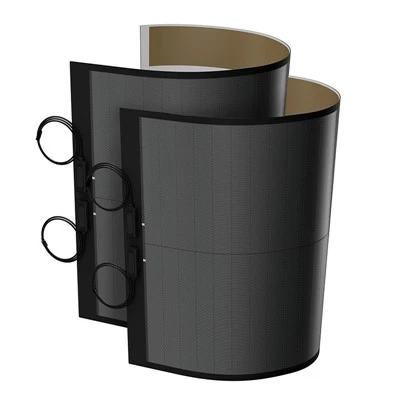
Product Overview
At sea, power is limited-but essential.
Navigation systems, communication devices, and onboard equipment all depend on a stable energy supply.
These marine flexible solar panels are built specifically for maritime conditions, offering:
- resistance to saltwater corrosion
- stable output in cloudy and humid environments
- flexible installation on curved decks and hulls
They are widely used on:
- yachts
- sailboats
- fishing vessels
- workboats

Parameters
| Parameter Categories | Parameter name | 110W 03N 2.6m |
210W 03M 1.7m |
300W 03W 1.7m |
500W 03W 2.6m |
|
| Electrical Parameters | Nominal power | 110W | 210W | 300W | 500W | |
| Conversion efficiency | 14.4% | 14.3% | 15.3% | 16.4% | ||
| Power tolerance | +5/0 W | +10/0 W | +10/0 W | +10/0 W | ||
| Maximum power voltage (Vmpp) | 28.4V | 18.1V | 38.1V | 62.4V | ||
| Maximum power current (Impp) | 3.89A | 11.65A | 7.89A | 8.03A | ||
| Open circuit voltage (Voc) | 36.3V | 23.2V | 48.0V | 77.2V | ||
| Short circuit current (Isc) | 4.66A | 一 | 9.21A | 9.07A | ||
| Maximum series fuse | 10A | 25A | 25A | 25A | ||
| Maximum system voltage | 1000V | 1000V | 1000V | 1000V | ||
| Thermal Properties | NOCT | 48℃ | 48℃ | 48℃ | 48℃ | |
| Power temperature coefficient | -0.38%/℃ | -0.38%/℃ | -0.38%/℃ | -0.38%/℃ | ||
| Voltage temperature coefficient | -0.28%/℃ | -0.28%/℃ | -0.28%/℃ | -0.28%/℃ | ||
| Mechanical Dimensions | Length | 2583mm | 1709mm | 1709mm | 2583mm | |
| Width | 348mm | 973mm | 1292mm | 1292mm | ||
| Thickness (at junction box) | 17mm | 17mm | 17mm | 17mm | ||
| Weight without adhesive | 1.7kg | 2.9kg | 3.7kg | 5.6kg | ||
| General Information | Battery type | CIGS | CIGS | CIGS | CIGS | |
| Junction box | IP68 | IP68 | IP68 | IP68 | ||
| Connector | MC4 | MC4 | MC4 | MC4 | ||
| Certifications | IEC61646/61 730 |
IEC61646/61 730 |
IEC61646/61 730 |
IEC61646/61 730 |
||
Key Capabilities
Reliable output in marine weather:
Performs well in cloudy, humid, and reflective ocean environments.
Built for saltwater exposure:
Fully sealed structure resists corrosion and long-term exposure.
Fits curved deck surfaces:
No gaps, no complex mounting systems.
Lightweight for vessel efficiency:
Reduces load impact on vessel performance.
Real-world challenges it solves
Marine users often face:
- generator noise and fuel dependency
- corrosion damage to equipment
- unstable power supply offshore
Solar integration reduces these issues significantly.


Business Value
For shipbuilders and marine suppliers:
- adds eco-friendly functionality to vessels
- reduces maintenance and after-sales issues
- improves product competitiveness in high-end markets
For operators:
- lowers fuel costs
- provides silent power
- supports long-duration trips

- Tested with 3000+ hours salt spray resistance
- Verified performance in marine environments
- Certified for international standards
- Applied in real vessel projects


CTA
Tell us your vessel type and power needs-we'll recommend a suitable marine solar configuration.
FAQ
Q: Are flexible solar panels suitable for marine environments?
A: Yes. Marine-grade panels are designed to resist saltwater, humidity, and long-term exposure at sea.
Q: Do solar panels work effectively on cloudy days at sea?
A: Yes. CIGS technology performs well in low-light and diffused light conditions common in marine environments.
Q: Can marine solar panels replace generators?
A: They can reduce generator usage significantly, especially for daily onboard power needs.
Hot Tags: flexible solar panels for boats, China flexible solar panels for boats manufacturers, suppliers, factory, CIGS Automotive Flexible Solar Panels, Flexible Solar Panels for Boats, Flexible Solar Panels for Car Roof, flexible solar panel, Flexible Solar Panels for Rv, Flexible Solar Panels for Van Roof