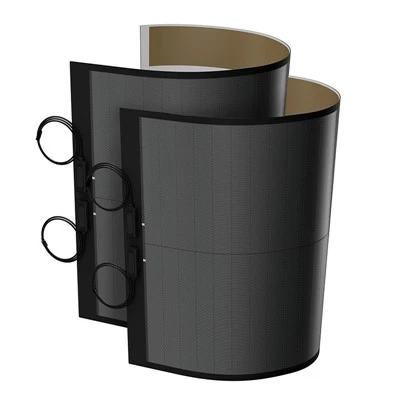
Product Overview
For many vehicles-especially EVs, fleet cars, and vans-battery drain is a real issue when parked or operating auxiliary systems.
This automotive CIGS flexible solar panel is built to solve that problem.
It integrates directly onto the vehicle roof, generating power throughout the day to support:
- battery maintenance
- ventilation systems
- telematics
- refrigeration units
No fuel, no extra wiring complexity, and no impact on vehicle structure.

Parameters
| Parameter Categories | Parameter name | 110W 03N 2.6m |
210W 03M 1.7m |
300W 03W 1.7m |
500W 03W 2.6m |
|
| Electrical Parameters | Nominal power | 110W | 210W | 300W | 500W | |
| Conversion efficiency | 14.4% | 14.3% | 15.3% | 16.4% | ||
| Power tolerance | +5/0 W | +10/0 W | +10/0 W | +10/0 W | ||
| Maximum power voltage (Vmpp) | 28.4V | 18.1V | 38.1V | 62.4V | ||
| Maximum power current (Impp) | 3.89A | 11.65A | 7.89A | 8.03A | ||
| Open circuit voltage (Voc) | 36.3V | 23.2V | 48.0V | 77.2V | ||
| Short circuit current (Isc) | 4.66A | 一 | 9.21A | 9.07A | ||
| Maximum series fuse | 10A | 25A | 25A | 25A | ||
| Maximum system voltage | 1000V | 1000V | 1000V | 1000V | ||
| Thermal Properties | NOCT | 48℃ | 48℃ | 48℃ | 48℃ | |
| Power temperature coefficient | -0.38%/℃ | -0.38%/℃ | -0.38%/℃ | -0.38%/℃ | ||
| Voltage temperature coefficient | -0.28%/℃ | -0.28%/℃ | -0.28%/℃ | -0.28%/℃ | ||
| Mechanical Dimensions | Length | 2583mm | 1709mm | 1709mm | 2583mm | |
| Width | 348mm | 973mm | 1292mm | 1292mm | ||
| Thickness (at junction box) | 17mm | 17mm | 17mm | 17mm | ||
| Weight without adhesive | 1.7kg | 2.9kg | 3.7kg | 5.6kg | ||
| General Information | Battery type | CIGS | CIGS | CIGS | CIGS | |
| Junction box | IP68 | IP68 | IP68 | IP68 | ||
| Connector | MC4 | MC4 | MC4 | MC4 | ||
| Certifications | IEC61646/61 730 |
IEC61646/61 730 |
IEC61646/61 730 |
IEC61646/61 730 |
||
Key Capabilities
Works even when the car is partially shaded:
Maintains output under roof racks, antennas, or uneven sunlight conditions.
Designed for real driving conditions:
Handles vibration, temperature fluctuation, and long-term outdoor exposure.
Fits curved roofs without structural changes:
No drilling required, no impact on aerodynamics.
Lightweight enough for OEM integration:
Adds minimal load, making it suitable for both EV and fuel vehicles.
Where it is actually used
This type of system is already used in:
- EVs for auxiliary battery support
- Fleet vehicles to reduce idle energy loss
- Refrigerated vans to support cooling systems
- Off-road and RV vehicles for off-grid power


Why not traditional solar panels?
Rigid panels don't work well on vehicles. They:
- Can't fit curved surfaces
- Are prone to cracking under vibration
- Reduce aerodynamic performance
Flexible CIGS panels solve these issues by adapting to the vehicle instead of forcing structural changes.

Business Value
For your business, this means:
fewer battery failures in parked vehicles
reduced maintenance cost for fleet operations
added product value for automotive customers
new selling point for EV and retrofit markets
Proof & Reliability
- Tested under continuous vibration and temperature cycling
- Maintains stable output in real driving conditions
- Certified for international compliance (CE, RoHS, REACH)
- Field-tested in vehicle applications


CTA
Tell us your vehicle type or project-we'll help you evaluate whether solar integration makes sense and provide a matching solution.
FAQ
Q: Can solar panels really work on moving vehicles?
A: Yes. Flexible panels are specifically designed to handle vibration and changing light conditions, making them suitable for real driving environments.
Q: Do automotive solar panels help extend EV range?
A: They don't replace charging, but they can support auxiliary systems and reduce battery drain, which indirectly improves efficiency.
Q: Is installation complicated for vehicle integration?
A: No. Most systems use adhesive mounting and require no structural modification.
Hot Tags: cigs automotive flexible solar panels, China cigs automotive flexible solar panels manufacturers, suppliers, factory, CIGS Automotive Flexible Solar Panels, Flexible Solar Panels for Boats, Flexible Solar Panels for Car Roof, flexible solar panel, Flexible Solar Panels for Rv, Flexible Solar Panels for Van Roof